
As the sad news of the death of co-founder and former CEO of Apple, Steve Jobs, hits the headlines, we pay tribute by sharing his ‘Presentation Secrets’ courtesy of Carmine Gallo.
1. Create memorable moments
Every Steve Jobs presentation has one moment that leaves everyone in awe. These ‘moments’ are scripted ahead of time to complement Steve Jobs’s slides, the Apple website, press releases and advertisements. At Macworld 2008, Jobs pulled the new MacBook Air out of a manila inter-office envelope to show everyone just how thin it was. Bloggers went nuts and it was the most common photograph of the event.

At last month’s ‘Rock & Roll’ event, the ‘water cooler’ moment wasn’t a product at all. Instead, it was Steve Jobs himself walking on stage after a long, health-related absence. He told the audience he now had the liver of a mid-twenties person who had died in a car crash and was generous enough to donate their organs. “I wouldn’t be here if it wasn’t for such generosity,” he said.
2. Stick to the rule of three
A Steve Jobs presentation is typically divided into three parts. The Rule of Three is one of most powerful concepts in dramatic writing –how many times have you seen a ‘two-act’ play? The human mind can only retain three or four ‘chunks’ of information, and Jobs is well aware of this principle. He even has a lot of fun with it.

During Macworld 2007, he teased the audience with ‘three’ revolutionary products: an MP3 player, a phone and an Internet communications device. Of course, he really only had one device — the iPhone.
3. Dress up the numbers
When Jobs introduced the iPod in 2001, he said it came with a 5GB hard-drive. Only the most technical audience would understand the implications of that number. Jobs broke it down by saying, “That’s enough storage for 1,000 songs.” He made the number even more compelling by announcing that all those songs could fit in your pocket. Apple presenters never leave big numbers hanging without putting those numbers in perspective.
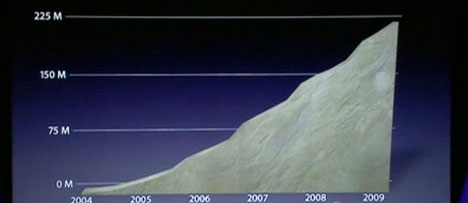
For example, during the ‘Rock & Roll’ music event, marketing head Phil Schiller announced that Apple had sold 220 million iPods to date. “That’s 73% of the market,” he said. Schiller took it one step further, and got a laugh, when he said Microsoft was ‘pulling up the rear’ with 1% market share.
4. Think visually
Apple presentations are strikingly simple and visual. For example, there is very little text on a Steve Jobs slide. While the average PowerPoint slide has forty words, there were far fewer than forty words in the first dozen slides of last week’s event. When Jobs talked about the popularity of iTunes around the world, his slide showed twenty-three flags of different countries instead of country names.

When he said the iPhone app store was celebrating its first anniversary, a slide appeared with a birthday cake holding one candle. When he talked about lower iPod prices, the new price was accompanied by photos of the iPods. Psychologists call this picture superiority: ideas are more easily recalled when presented with text and images instead of text alone.
5. Create Twitter-friendly headlines
Apple makes it simple for the media to talk about its products — the company writes the headlines for them. Now, reporters will tell you that they like to come up with their own headlines, but why then did hundreds of them use “World’s thinnest notebook” to describe the MacBook Air? Because it’s the best way to describe it. It’s the world’s thinnest notebook. Period.

Steve Jobs always describes a new product with a concise phrase that fits well within a 140-character Twitter post. What’s an iPod? “One thousand songs in your pocket.” What’s Genius Mix for iTunes? “It’s like having a DJ mix the songs in your library.”
6. Share the stage
Jobs rarely gives an entire presentation by himself. Instead he surrounds himself with a supporting cast. He had a large supporting cast at the September 9 music event, including Apple VPs Jeff Robbin and Phil Schiller.

In October 2008 Jobs introduced lead designer Jonathan Ive, who gave the audience a tutorial about Apple’s newest line of aluminium MacBooks. Although few companies are more closely associated with their founder than Apple, a Jobs presentation is rarely a one-man play. He features supporting characters who play a key role in the narrative.
7. Practise, practise and practise more
According to some observers, Steve Jobs labours over every slide, each one “written like a piece of poetry.” Jobs has been known to spend hours upon hours over many days rehearsing every section of his keynotes. Nothing is left to chance. Jobs makes a presentation look effortless because he has spent hours preparing it.
8. Sell dreams, not products
Steve Jobs is passionately committed to changing the world and his passion shows in every presentation. In May 2005, Steve Jobs told Stanford graduates, “Your work is going to fill a large part of your life… and the only way to do great work is to love what you do.” Anyone can learn the specific techniques Jobs uses to create visually creative slides and to craft an interesting story, but that message will fail to inspire an audience if there’s no enthusiasm behind it. Jobs has a nearly messianic zeal to change the world. In your own way, so should you.
9. Introduce the antagonist
In every classic story, the hero fights the villain. The same holds true for a Steve Jobs presentation. In 1984, the villain was IBM, “Big Blue.” Before Jobs introduced the famous 1984 Ridley Scott ad to the Apple sales team, he painted a picture of Big Blue “bent on world domination” with Apple as the only one to stand in its way. Conquering a shared enemy is a powerful motivator, attracting fans and followers.
10. One more thing… Have Fun!
Jobs has fun and it shows. Despite relentless planning and hours of rehearsal, sometimes thing go wrong, but Jobs doesn’t let the small stuff get to him. Jobs’s clicker failed to advance the slides during a portion of the iPhone introduction during Macworld 2007. Jobs paused and told a very funny story about the time he and friend Steve Wozniak would hang out in Wozniak’s college dorm with a device that would screw up TV signals. It was a glimpse of Jobs the prankster. Most presenters would have frozen. Jobs acted with cool confidence because he’s up there to have fun. It’s not about the slides.
This presentation article first appeared on Cult of Mac.
Carmine Gallo is a communications coach and author of The Presentation Secrets of Steve Jobs: How to be Insanely Great in Front of Any Audience.
Thanks to Carmine Gallo for allowing us to publish this.
Published On: 6th Oct 2011
Read more about -Public Speaking,Speaking Articles , Presentation Secrets
-
Loved the article and the examples. Jobs is a master, but so many of his techniques can be used by anyone. Thanks
-
simply inspiring…
-
lovely ! I ‘m gonna need this inspiring idea for my important presentation next month. Thank you
-
Highly inspiratioal for small businesses to learn how to participate in seminars and exhibits.
-
Very tanks to you
I have a presentation tomarrow and it will be very usefull for me.
very easy and very usefulltanks again 🙂
-
wow, Jobs enthusiasm and passion trully rubs off on u
-
good and intresting
-
Simply Guiding and Inspiring
-
Very inspiring !
-
Thanks for the article. Steve is the master in my mind when it comes to presentations.
-
Simply Very best and very inspiring.